Hedgehog Facts
Conservation status
The European hedgehog (Erinaceus europaeus) has long been one of Europe's most familiar and well-loved wild mammals, but its conservation status is now a major concern.
It is now listed as “Near Threatened” globally on the IUCN Red List and “Vulnerable to Extinction” in Great Britain.
It is protected in the UK under the Wildlife and Countryside Act, 1981, and a Priority Species under the UK Post-2010 Biodiversity Framework.
This alarming decline is due mainly to human activity, including loss of habitat due to modern farming methods and urban sprawl, the use of chemical pesticides that destroy their main source of food, and road hazards.
Basic Facts
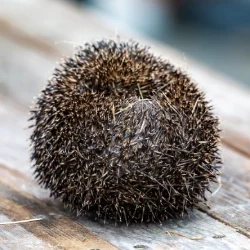
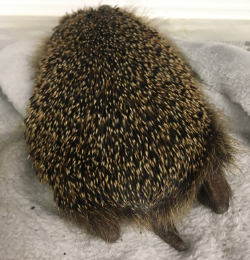
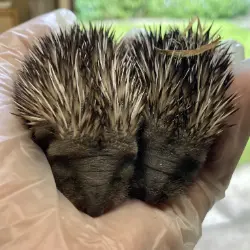
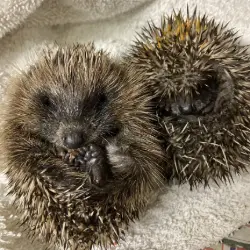
Hedgehogs are easily recognised as a brown ball of about 7000 sharp spines, with a furry face if you can see it (and a furry belly that you won’t often see). Males and females look exactly the same to an observer. (Just to confuse the issue, both male and female hogs have a short tail, which is often tucked up underneath them.) The only way to tell them apart is to get a close look at their undercarriage - which requires an unusual degree of cooperation from the hedgehog, so is best left to experienced rehabbers! Similarly, a female shows no outward sign of pregnancy, so short of a veterinary scan the first sign is usually the arrival of a litter of hoglets.
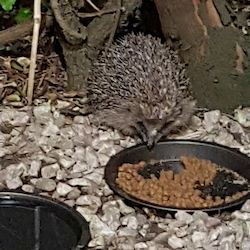
Widely known as nocturnal, they are also crepuscular, (derived from the Latin for “twilight”), particularly during the summer months when nights are shorter and they don’t want to wait for full dark to find their breakfast.
Hedgehogs also have longer legs than most people realise, since they are largely hidden under the hedgehog’s skirt. Just as well, since they can walk between 1 and 2 miles in a night, looking for food or a mate. They will visit several gardens each night to find enough to eat, so hedgehog highways are an enormous help to them.
They are solitary animals but not territorial, so they tolerate each other most of the time when they meet, although males can be more aggressive during the mating season. They often have 2 or 3 nests in different places rather than a permanent home, moving from one to another as the mood takes them.
Somewhat appropriately, a group of hedgehogs is known as a “prickle”.
Breeding Cycle
Hedgehogs breed from April to September, with the peak being in May and June. The males are very determined in courtship, circling a female for hours while she turns warily and huffs a lot, until she is sufficiently impressed by his perseverance and stamina to allow him to mate. Job done, he will then leave in search of the next (possibly) willing female. Females are no more constant, ever searching for the best genetic advantage for their offspring, and it is not unusual for hoglets from the same litter to have different paternity.
A hedgehog pregnancy lasts about 34 days. Just before a female gives birth, you may well see her out during the day busily collecting last-minute extra bedding as she realises that the nursery isn’t ready yet and the infants are about to appear. This is the one time that she does NOT need rescuing when out in the day!
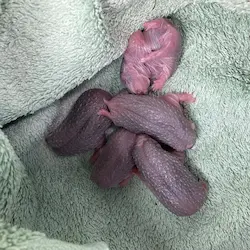
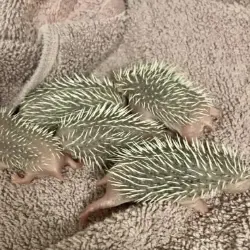
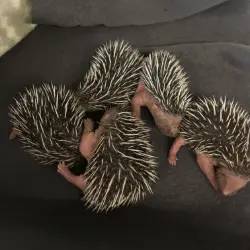
A litter can be anywhere from 1 to 10 hoglets, although 4 to 6 is the usual. The hoglets are born with their eyes closed and their first spines visible under the skin. The white spines start to emerge after a couple of hours, but the eyes usually open after 10 -14 days. The mother will try to protect her young from predators , but if the nest is disturbed she may abandon them or even attack and eat them. The hoglets will start leaving the nest to forage with their mother at about 4 weeks old, and after 6 or 7 weeks they are independent and will disperse. The mother will spend some time replenishing her own resources and will be able to breed again and produce her second litter of hoglets in late autumn.
Eating habits
Hibernation
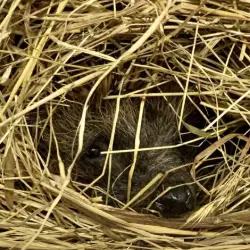
Hedgehogs typically hibernate some time from October to April, but it depends very much on the weather and the hedgehog! Some might hibernate sooner, some later, some for longer and some not at all. Even those who hibernate may wake up during a warm spell, then go back into hibernation when the weather changes.
Before hibernating, a hedgehog will prepare a nest known as a Hibernacula. These can be in long grass, scrub, log piles, compost heaps, leaf piles, under bushes, under sheds, under decking, in bags of rubbish, under barbeque or garden furniture covers, or anywhere else you don’t expect to find them - which makes them particularly vulnerable to careless gardeners. If you provide a good solid wooden hedgehog house, they might even use that instead.
Before hibernating a hog will concentrate on gaining fat reserves and will require sufficient food to do that. During hibernation they enter a state of torpor where the heartbeat will slow to about 20 beats per minute, breathing and metabolism will slow, body temperature falls to match their surroundings, and the hog will lose approximately 2-3g of body weight per day. If disturbed/discovered please do not presume it is dead. They may ripple their spines in response to touch or possibly produce a little hiss - but that’s all they can do whilst in the hibernation state. It can take 12-24 hrs for them to restart their metabolism in order to awaken properly.
Hedgehog Fleas
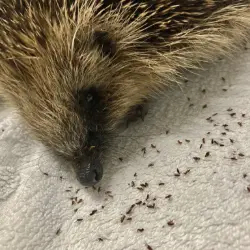
There is a common misconception that all hedgehogs are covered in fleas that pose a danger of infecting pet cats and dogs. This is not true.
In fact, very few hedgehogs have fleas. A flea infestation is normally a sign of a very sick hedgehog that needs urgent rescue, although again it is only a very small number of sick hogs that actually have fleas.
The best news of all is that hedgehog fleas are species-specific. Even if you do encounter them, they are unable to survive on you, or in your carpets or on your household pets.
Please remember that dog/cat flea treatments are toxic to hedgehogs - rehabbers use a special spray for exotic birds.
Ticks
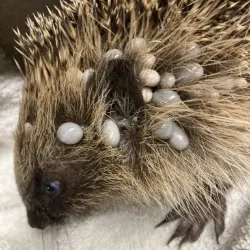
Unlike fleas, ticks are quite common on hedgehogs, but normally in small numbers. The odd tick or two is nothing to worry about - they will eventually drop off.
A large number of ticks on a hedgehog is cause for concern, as they can cause anaemia. They are also a warning sign that the hedgehog is likely to be suffering from an underlying illness that has already weakened it. In this case, the hedgehog needs to be taken to a rescue.
Never attempt to remove ticks from a hedgehog yourself. Without the proper tool to remove the tick safely there is a danger of infection, and many over-the-counter tick and flea products can be fatal to hedgehogs.
Ringworm
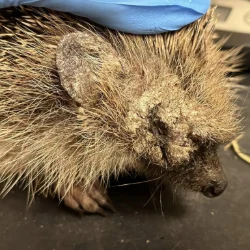
Contrary to its name, ringworm is not actually a worm or any kind of parasite - it is a fungal skin infection affecting both people and animals. It is commonly caught from infected soil, direct skin-to-skin contact or from contaminated objects like nest materials. (When you get it on your feet it is known as Athlete’s Foot.)
In hedgehogs it can be seen as crusty, flaky skin or bald patches where hair and spines have fallen out. It can also exist only as small patches on the nose or under the skirt that are not obvious without a close clinical examination. In severe cases it can damage the skin creating open cracks that become infected. Some hedgehogs with ringworm will also have mange mites.
If 7000 spines aren’t enough to discourage you from picking up a hedgehog with your bare hands, then the possibility of ringworm is another good reason to always wear gloves or use a towel to pick up a wild hedgehog.
Internal Parasites
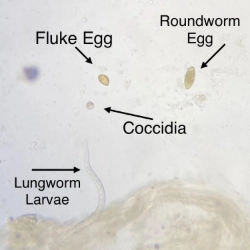
Most hedgehogs carry a few internal parasites, frequently acquired by eating infected prey such as slugs, snails and earthworms. As long as the hedgehog is healthy these don’t cause any major problems, but when the hedgehog is weakened by hunger, injury or stress, the parasites can start to get the upper hand resulting in symptoms such diarrhea, lethargy, coughing, and weight loss.
The most common internal parasites in hedgehogs are roundworm, lungworm, fluke and coccidia.
They are all diagnosed in the same way - by microscopic examination of a fecal sample.This often reveals more than one variety of parasite and enables the rehabber to work out a suitable treatment plan for all the problems present.
So now you know why rehabbers are so fond of doing Poo Tests!